


Page 48 - Mann Ki Baat - English
P. 48
India’s journey with coffee spans more
                               than  four  centuries,  beginning  in  the  17th
                               century in the hills of Chikkamagaluru,
                               Karnataka. Over time, India has become one
                               of the few coffee producing countries in the
                               world which produces both Washed Arabicas
                               and Washed Robustas, combining traditional
                               cultivation with modern processing. Today, it
                               stands  recognised  for  its  distinctive  flavour
                               profiles, responsible cultivation systems, and a
                               thriving network of producers, innovators, and
                               entrepreneurs. As India celebrates a century
                               of scientific coffee research and development
                               at the Central Coffee Research Institute
                               (CCRI), the nation’s coffee story continues to
                               unfold with renewed purpose and pride.
                                  The Uniqueness
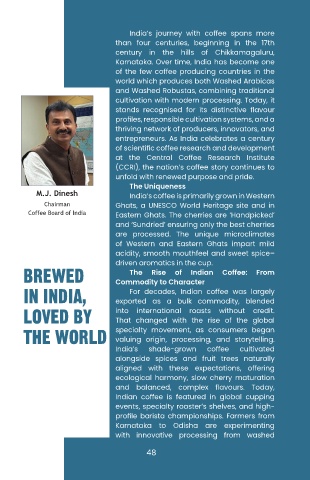
          M.J. Dinesh             India’s coffee is primarily grown in Western
            Chairman           Ghats, a UNESCO World Heritage site and in
        Coffee Board of India  Eastern Ghats. The cherries are ‘Handpicked’

                               and ‘Sundried’ ensuring only the best cherries
                               are processed. The unique microclimates
                               of Western and Eastern Ghats impart mild
                               acidity, smooth mouthfeel and sweet spice–
                               driven aromatics in the cup.
       BREWED                  Commodity to Character     Coffee:  From
                                        Rise
                                                  Indian
                                  The
                                              of
       IN INDIA,               exported as a bulk commodity, blended
                                  For decades, Indian coffee was largely
       LOVED BY                into international roasts without credit.
                               That changed with the rise of the global
       THE WORLD               specialty  movement, as  consumers began
                               valuing origin, processing, and storytelling.
                               India’s  shade-grown   coffee  cultivated
                               alongside spices and fruit trees naturally
                               aligned with these expectations, offering
                               ecological harmony, slow cherry maturation
                               and  balanced,  complex  flavours.  Today,
                               Indian coffee is featured in global cupping
                               events, specialty roaster’s shelves, and high-
                               profile  barista  championships.  Farmers  from
                               Karnataka to Odisha are experimenting
                               with innovative processing from washed

                                      48
                                      48

