


Page 33 - Mann Ki Baat English
P. 33
its  historical,  cultural,  and
          spiritual   significance.   Public
          dialogues,   workshops,   and
          discussions fostered the belief
          that river conservation is self-
          conservation.”
              This campaign gradually
          became a mass movement.
          The biggest challenge was
          to change people's mindsets
          and    coordinate   with  the
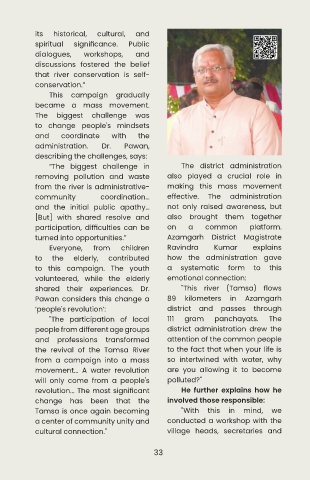
          administration.  Dr.   Pawan,
          describing the challenges, says:
              “The biggest challenge in        The district administration
          removing pollution and waste      also played a crucial role in
          from the river is administrative-  making  this  mass  movement
          community        coordination…    effective.  The  administration
          and the initial public apathy…    not only raised awareness, but
          [But] with shared resolve and     also brought them together
          participation,  difficulties  can  be   on  a  common  platform.
          turned into opportunities.”       Azamgarh District  Magistrate
              Everyone,  from   children    Ravindra    Kumar     explains
          to  the   elderly,  contributed   how the administration gave
          to this campaign. The youth       a systematic form to this
          volunteered, while the elderly    emotional connection:
          shared their experiences. Dr.        "This  river  (Tamsa)  flows
          Pawan  considers  this  change  a   89  kilometers  in  Azamgarh
          ‘people's revolution’:            district and passes through
              "The participation of local   111  gram   panchayats.   The
          people from different age groups   district administration drew the
          and professions  transformed      attention of the common people
          the revival of the Tamsa River    to the fact that when your life is
          from a campaign into a mass       so intertwined with water, why
          movement... A water revolution    are you allowing it to become
          will only come from a people's    polluted?"
          revolution... The most significant   He further explains how he
          change has been that the          involved those responsible:
          Tamsa is once again becoming         "With this in mind, we
          a center of community unity and   conducted a workshop with the
          cultural connection."             village heads, secretaries and


                                        33
                                        33
                                        33

