


Page 22 - MAAN KI BAAT - ENGLISH
P. 22
NDRF was raised on Jan 19, 2006 as a multi-
                             skilled and specialised disaster response force
                             under the Disaster Management (DM) Act, 2005
                             and mandated to respond to all natural and
                             man-made disasters in the country and even
                             outside. Presently, the Force has 16 Battalions.
                             Each battalion has 18 specialised Search and
                             Rescue teams which are self-contained and
                             have specialists such as engineers, technicians,
                             electricians,  dog  squads  and   medical/
                             paramedical personnel.
                                 As per the SOP of NDRF issued by MHA, it can
                             be requisitioned for deployment by the Principal
                             Secretaries of the States dealing with DM, Relief
                             Commissioners of the States and DCs/DMs of
                             the districts. The authorities authorised to accept
                             the requisitions are MHA, DG NDRF and NDRF Unit
                             Commandants. Many a time, NDRF, on the basis
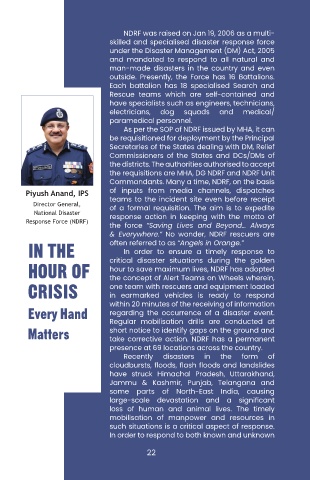
        Piyush Anand, IPS    of inputs from media channels, dispatches
                             teams to the incident site even before receipt
          Director General,   of a formal requisition. The aim is to expedite
          National Disaster   response action in keeping with the motto of
        Response Force (NDRF)
                             the force  “Saving Lives and Beyond… Always
                             & Everywhere.”  No  wonder,  NDRF  rescuers are
        IN THE               often referred to as “Angels in Orange.”
                                 In order to ensure a timely response to
        HOUR OF              critical disaster situations during the  golden
                             hour to save maximum lives, NDRF has adopted
                             the concept of Alert Teams on Wheels wherein,
        CRISIS               one team with rescuers and equipment loaded
                             in earmarked vehicles is ready to respond
        Every Hand           within 20 minutes of the receiving of information
                             regarding  the  occurrence  of  a  disaster  event.
                             Regular mobilisation drills are conducted at
        Matters              short notice to identify gaps on the ground and
                             take  corrective  action.  NDRF  has  a  permanent
                             presence at 69 locations across the country.
                                 Recently  disasters  in  the  form  of
                             cloudbursts, floods, flash floods and landslides
                             have struck Himachal Pradesh, Uttarakhand,
                             Jammu & Kashmir, Punjab, Telangana and
                             some  parts  of North-East  India, causing
                             large-scale  devastation  and  a  significant
                             loss of human and animal lives. The timely
                             mobilisation of manpower and resources in
                             such situations is a critical aspect of response.
                             In order to respond to both known and unknown

                                       22
                                       22

