


Page 72 - Mann Ki Baat - English
P. 72
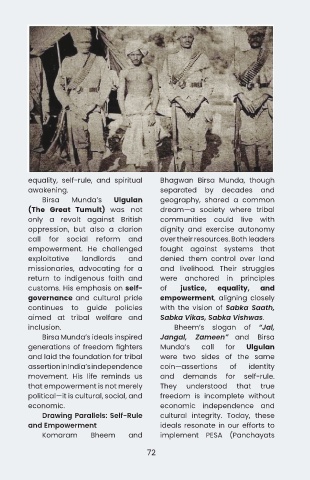
equality, self-rule, and spiritual   Bhagwan Birsa Munda, though
        awakening.                        separated by decades and
            Birsa  Munda’s    Ulgulan     geography, shared a common
        (The  Great  Tumult)  was not     dream—a society where tribal
        only a revolt against British     communities could live with
        oppression, but also a clarion    dignity and exercise autonomy
        call for social reform and        over their resources. Both leaders
        empowerment. He challenged        fought against systems that
        exploitative  landlords   and     denied them control over land
        missionaries, advocating for a    and livelihood. Their struggles
        return to indigenous faith and    were anchored in principles
        customs. His emphasis on self-    of   justice,  equality,  and
        governance  and cultural pride    empowerment, aligning closely
        continues to guide policies       with  the  vision  of  Sabka Saath,
        aimed at tribal welfare and       Sabka Vikas, Sabka Vishwas.
        inclusion.                            Bheem’s slogan of  “Jal,
            Birsa Munda’s ideals inspired   Jangal, Zameen”  and  Birsa
        generations of freedom fighters   Munda’s    call  for  Ulgulan
        and laid the foundation for tribal   were two sides of the same
        assertion in India’s independence   coin—assertions  of  identity
        movement. His life reminds us     and demands for self-rule.
        that empowerment is not merely    They   understood  that   true
        political—it is cultural, social, and   freedom is incomplete without
        economic.                         economic  independence  and
            Drawing Parallels: Self-Rule   cultural integrity. Today, these
        and Empowerment                   ideals resonate in our efforts to
            Komaram     Bheem     and     implement PESA (Panchayats

                                       72
                                       72

