


Page 70 - Mann Ki Baat - English
P. 70
India’s freedom struggle is often narrated
                               through the stories of great leaders and
                               movements, but the valiant contributions
                               of  tribal  icons  like  Komaram  Bheem  and
                               Bhagwan  Birsa  Munda  remain  equally
                               significant.  Their  lives  were  a  testament
                               to courage, resilience, and an unwavering
                               commitment to justice and dignity for their
                               people.  As  we  celebrate  Janajatiya Gaurav
                               Diwas,  it  is  imperative  to  reflect  on  their
                               legacy and the values they stood for.
                                  Komaram     Bheem:    A   Symbol   of
                               Resistance and Rights
                                  Komaram  Bheem’s  fight  against  the
                               oppressive Nizam rule in Hyderabad was
                               not merely a local rebellion; it represented
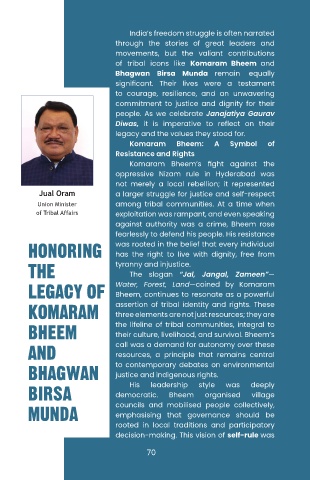
           Jual Oram           a larger struggle for justice and self-respect
           Union Minister      among tribal communities. At a time when
          of Tribal Affairs    exploitation was rampant, and even speaking
                               against authority was a crime, Bheem rose
                               fearlessly to defend his people. His resistance
        HONORING               was rooted in the belief that every individual
                               has the right to live with dignity, free from
        THE                    tyranny and injustice.
                                  The slogan “Jal, Jangal, Zameen”—
        LEGACY OF              Water, Forest, Land—coined by Komaram

                               Bheem, continues to resonate as a powerful
        KOMARAM                assertion of tribal identity and rights. These
                               three elements are not just resources; they are
        BHEEM                  the lifeline of tribal communities, integral to
                               their culture, livelihood, and survival. Bheem’s
        AND                    call was a demand for autonomy over these
                               resources,  a  principle  that  remains  central
        BHAGWAN                to contemporary debates on environmental
                               justice and indigenous rights.
        BIRSA                  democratic.  Bheem   style  was   deeply
                                  His
                                       leadership
                                                                 village
                                                     organised
        MUNDA                  councils and mobilised people collectively,
                               emphasising that governance should be
                               rooted  in  local  traditions  and  participatory
                               decision-making. This vision of self-rule was

                                       70
                                       70

