


Page 24 - Mann Ki Baat English
P. 24
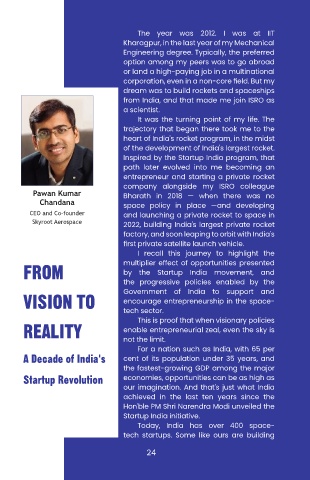
The year was 2012. I was at IIT
                                 Kharagpur, in the last year of my Mechanical
                                 Engineering degree. Typically, the preferred
                                 option among my peers was to go abroad
                                 or land a high-paying job in a multinational
                                 corporation, even in a non-core field. But my
                                 dream was to build rockets and spaceships
                                 from India, and that made me join ISRO as
                                 a scientist.
                                    It was the turning point of my life. The
                                 trajectory that began there took me to the
                                 heart of India's rocket program, in the midst
                                 of the development of India's largest rocket.
                                 Inspired by the Startup India program, that
                                 path later evolved into me becoming an
                                 entrepreneur  and  starting  a  private  rocket
                                 company alongside my ISRO colleague
         Pawan Kumar             Bharath in 2018 — when there was no
           Chandana
                                 space policy in place —and developing
         CEO and Co-founder      and launching a private rocket to space in
         Skyroot Aerospace
                                 2022, building India's largest private rocket
                                 factory, and soon leaping to orbit with India's
                                 first private satellite launch vehicle.
                                    I recall this journey to highlight the
       FROM                      multiplier effect of opportunities presented
                                 by the Startup India movement, and
                                 the  progressive  policies  enabled  by  the
       VISION TO                 Government of India to support and
                                 encourage entrepreneurship in the space-
                                 tech sector.
                                    This is proof that when visionary policies
       REALITY                   enable entrepreneurial zeal, even the sky is
                                 not the limit.
                                    For a nation such as India, with 65 per
       A Decade of India's       cent of its population under 35 years, and
                                 the fastest-growing GDP among the major
       Startup Revolution        economies, opportunities can be as high as
                                 our imagination. And that's just what India
                                 achieved in the last ten years since the
                                 Hon'ble PM Shri Narendra Modi unveiled the
                                 Startup India initiative.
                                    Today, India has over 400 space-
                                 tech  startups.  Some  like  ours  are  building

                                      24
                                      24

