


Page 44 - Mann ki Baat English Feb 2026
P. 44
Organ donation in India stands as one
                                 of the most profound and compassionate
                                 acts a person can undertake, transforming
                                 personal loss into renewed life and hope.
                                 It is far more than a medical procedure; it
                                 reflects  a  shared  social  responsibility  and
                                 our collective conscience as a nation. Organ
                                 transplantation today demonstrates how
                                 medical science,  responsive public  policy,
                                 and citizen participation can converge to
                                 save lives. Over the past decade, India has
                                 steadily built a transparent and nationally
                                 coordinated    transplant   ecosystem
                                 grounded in accountability, technology,
                                 and growing public trust.
                                    The   Hon’ble  Prime  Minister,  Shri
                                 Narendra Modi, has been emphasising the
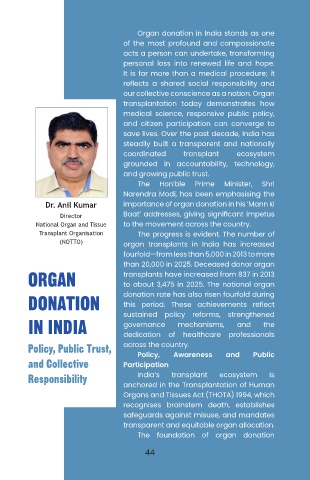
             Dr. Anil Kumar      importance of organ donation in his ‘Mann ki
                Director         Baat’ addresses, giving significant impetus
          National Organ and Tissue   to the movement across the country.
           Transplant Organisation   The progress is evident. The number of
                (NOTTO)
                                 organ transplants in India has increased
                                 fourfold—from less than 5,000 in 2013 to more
                                 than 20,000 in 2025. Deceased donor organ
        ORGAN                    transplants have increased from 837 in 2013
                                 to about 3,475 in 2025. The national organ
        DONATION                 donation rate has also risen fourfold during
                                 this  period.  These  achievements  reflect
        IN INDIA                 sustained policy reforms, strengthened
                                                                    the
                                                              and
                                              mechanisms,
                                 governance
                                 dedication of healthcare professionals
        Policy, Public Trust,    across the country.       and    Public
                                    Policy,
                                             Awareness
        and Collective           Participation
        Responsibility              India’s  transplant  ecosystem    is
                                 anchored in the Transplantation of Human
                                 Organs and Tissues Act (THOTA) 1994, which
                                 recognises brainstem death, establishes
                                 safeguards against misuse, and mandates
                                 transparent and equitable organ allocation.
                                    The foundation of organ donation

                                      44
                                      44

