


Page 70 - Mann ki Baat July 2026 English
P. 70
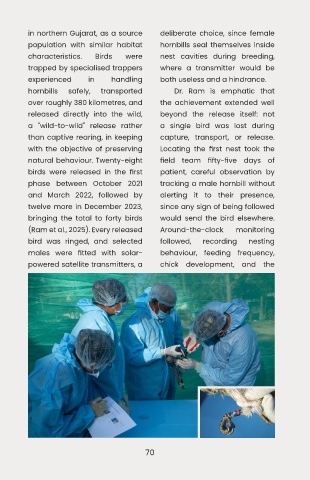
in northern Gujarat, as a source   deliberate choice, since female
        population with similar habitat   hornbills seal themselves inside
        characteristics.  Birds  were     nest cavities during breeding,
        trapped by specialised trappers   where a transmitter would be
        experienced     in   handling     both useless and a hindrance.
        hornbills  safely,  transported       Dr. Ram is emphatic that
        over roughly 380 kilometres, and   the achievement extended well
        released  directly  into  the wild,   beyond  the release  itself:  not
        a "wild-to-wild" release rather   a single bird was lost during
        than captive rearing, in keeping   capture, transport, or release.
        with  the  objective  of preserving   Locating  the  first  nest  took  the
        natural behaviour. Twenty-eight   field  team  fifty-five  days  of
        birds  were  released  in  the  first   patient, careful observation by
        phase between October 2021        tracking a male hornbill without
        and  March  2022,  followed  by   alerting it to their presence,
        twelve more in December 2023,     since any sign of being followed
        bringing the total to forty birds   would send the bird elsewhere.
        (Ram et al., 2025). Every released   Around-the-clock  monitoring
        bird was ringed, and selected     followed,  recording   nesting
        males  were  fitted  with  solar-  behaviour,  feeding frequency,
        powered satellite transmitters, a   chick development, and the


                                       70
                                      70

