


Page 28 - Mann Ki Baat - English
P. 28
Maha Kumbh Through the Ages


                                A Journey of Faith and Heritage


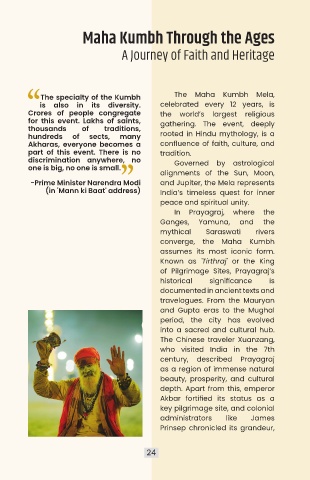
           The specialty of the Kumbh         The Maha Kumbh Mela,
           is also in its diversity.      celebrated every 12 years, is
        Crores of people congregate       the world’s largest religious
        for this event. Lakhs of saints,   gathering. The event, deeply
        thousands     of    traditions,
        hundreds    of  sects,  many      rooted in Hindu mythology, is a
        Akharas, everyone becomes a       confluence of faith, culture, and
        part of this event. There is no   tradition.
        discrimination  anywhere,  no         Governed  by astrological
        one is big, no one is small.
                                          alignments of the Sun, Moon,
         -Prime Minister Narendra Modi    and Jupiter, the Mela represents
             (in 'Mann ki Baat' address)  India’s timeless quest for inner
                                          peace and spiritual unity.
                                              In Prayagraj, where the
                                          Ganges,   Yamuna,   and   the
                                          mythical    Saraswati   rivers
                                          converge, the Maha Kumbh
                                          assumes  its  most  iconic  form.
                                          Known as  'Tirthraj' or the King
                                          of Pilgrimage Sites, Prayagraj’s
                                          historical   significance   is
                                          documented in ancient texts and
                                          travelogues. From the Mauryan
                                          and Gupta eras to the Mughal
                                          period, the city has evolved
                                          into a sacred and cultural hub.
                                          The Chinese traveler Xuanzang,
                                          who visited India in the 7th
                                          century, described  Prayagraj
                                          as a region of immense natural
                                          beauty, prosperity, and cultural
                                          depth. Apart from this, emperor
                                          Akbar  fortified  its  status  as  a
                                          key pilgrimage site, and colonial
                                          administrators   like  James
                                          Prinsep chronicled its grandeur,


                                      24
                                      24

